
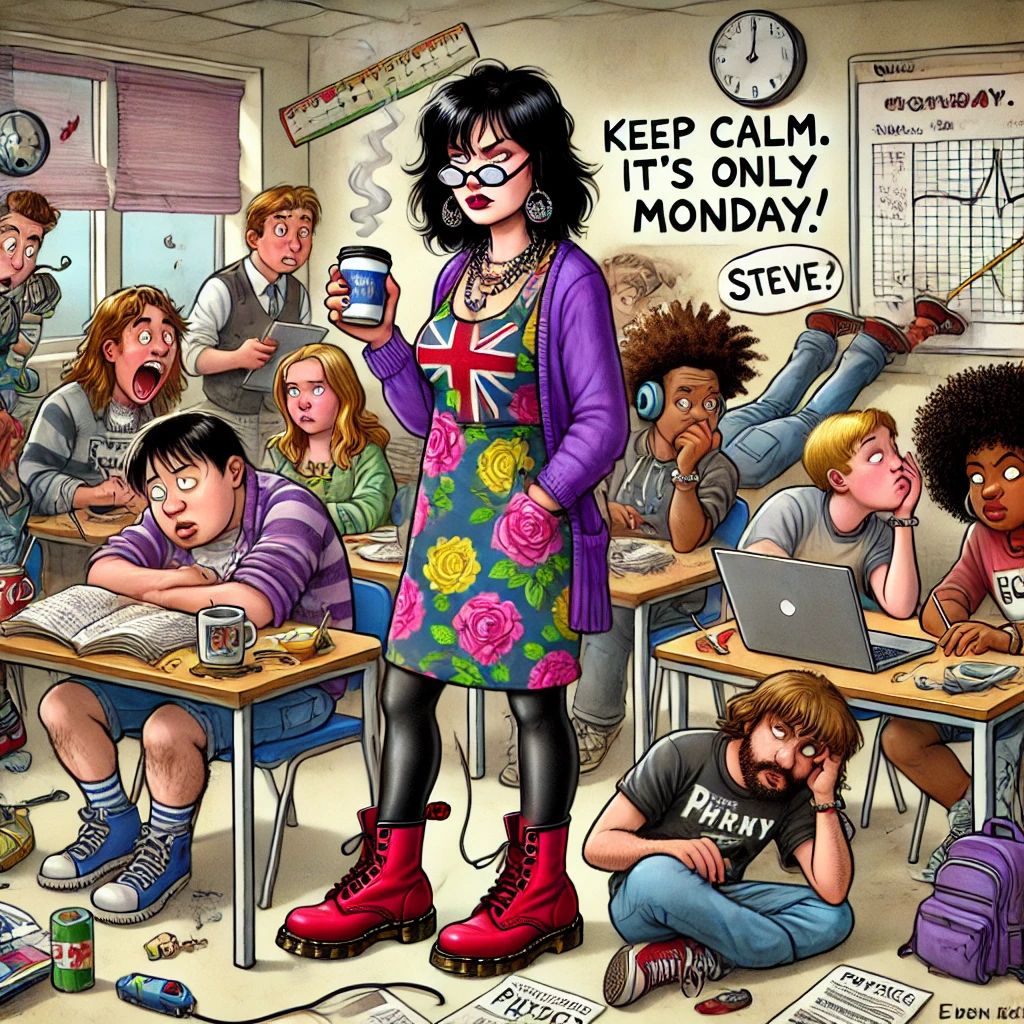
Monday Mornings & classroom management
Monday. 9am. The battleground is not physical—it’s mental, emotional, and occasionally existential. The troops? A vibrant, multicultural, neurodiverse bunch with enough energy to power the National Grid (if only I could find a way to harness it).
Lesson planning starts well before the register is even opened. My thoughts immediately go to each student’s needs—and my own, which usually include coffee, patience, and a backup plan for the backup plan.
Period 1: The Art of Tactical Teaching
Today’s class is a full house of needs, quirks, talents and unpredictabilities:
- ADHD (unmedicated): Must have printed notes, fidget tools, and activities that keep hands busy and minds focused. Group work is great—as long as it’s structured enough to stop wandering to the next table, sliding off chairs, or exiting the room altogether. Frequent mood checks are essential. A smile? Good sign. A scowl? Time for a quick redirection.
- Autism: Clear, calm instructions. Extra work available if needed. Group work handled gently—team player not, but the team’s unpaid project manager.
- Mental health challenges x5, medical needs x3: Flexible attendance, extra resources, breaks on demand, phones permitted for information access (not TikTok), and reminders that “toilet break” doesn’t mean a 20-minute tour of the building.
Structure is king. Changes? Must be telegraphed like you’re announcing a royal event. And always—always—keep calm. No matter what unfolds, it could still be a great lesson.
Disruptions? Naturally.
One student offers impromptu commentary mid-lesson, another drums a rhythm on the table. I walk the room like a general on patrol, reinforcing expectations with gentle nudges and whispered clarifications.
Period 2: Physics with a Plot Twist
Just before the bell rings, I’m informed we have a new student joining. Five-minute warning. Delightful. He’s fresh off the international plane of education and has never been through the UK system.
I set the rest of the class to work and turn to greet our newcomer—who, to my joy, has arrived with the entire contents of WHSmith in his bag. Fountain pen, colour pens, a full ruler set, sharpener, a rubber… a rare view, notebook with actual squares. I nearly cried.
Note to self: restock classroom stationery again. Our board pens keep mysteriously vanishing—possibly through a wormhole.
Back to the group. 18 students:
- 7 neurodiverse
- 1 with mental health needs
- 1 with a medical condition
- 1 new arrival with pristine stationery
- 1 Steve
Starter activity? Ready and prepped. I need ten minutes to circulate, make sure they’re not writing physics formulas on TikTok. But alas, half the class treats this time like a warm-up nap. I remind them—pens out, calculators ready, starter sheet is not optional.
The Steve Saga
He greets me every lesson with the biggest grin in history. Then sits. And stares. Philosophically. Possibly contemplating the meaning of the starter sheet. I greet him, we chat, and then, after a moment of epiphany, he announces, “A starter, Miss!” as though he’s uncovered the Rosetta Stone.
Together, we begin the great archaeological dig through his bag for stationery and a folder. We file papers. I asked him to collect the starter sheet. I move on. Mission accepted.
Meanwhile, drama erupts at the back. A pen theft scandal. Baba believes someone’s stolen his pen. Zara insists it’s just Baba being Baba. Papers are strewn everywhere like educational confetti. Miraculously, the pen is found. Baba delivers an apology like he’s at a UN summit. We move on.
Back to Steve.
Steve has returned—with a Year 13 booklet. We’re in Year 12. He’s already knee-deep in material from a topic he hasn’t met yet. My face freezes. I glance over to the other table. Three more students have mysteriously swapped their starter sheets for the class workbook.
How? When?
I ask why.
They blink.
I ask how.
Still blinking.
Jerrel finally pipes up: “You told Steve not to do those questions… so we thought we had to stop too.”
Reader, I smiled through the internal scream.
“Let’s go through the starter together. Who got the answer to question 1?” I say, like someone who hasn’t just lived through a mini soap opera.
No matter how carefully I plan, I always wonder what they actually hear when I speak. How do they manage to get the starter so wrong? Every time? But despite the chaos, I genuinely enjoy them. They surprise me daily, give me grey hair, and raise my blood pressure like an espresso shot to the heart—but I’m never bored. And in Further Education, that’s practically a win.
– Miss P, master of the unexpected
ChalkCode & Coffee: survival in Further Education

 SurvivingFE
Leave a comment